
Ever typed a question into Google and found a quick answer waiting at the top of the results? That’s AEO in action.
People are not just scrolling through blue links anymore. They ask full questions and expect direct answers. Search engines and AI tools now provide summaries, recommendations, and near-complete responses.
This shift is changing how customers discover businesses online. SEO still matters, but businesses also need content that search engines, voice assistants, and AI platforms can easily understand and feature. In other words, you want to show up inside the answer, not just below it. That’s exactly what Answer Engine Optimization, or AEO, is designed to do.
What Is AEO in Marketing?
Many businesses, especially startups, are still asking, “What is AEO in marketing, and how can it help my brand?”
Simply put, Answer Engine Optimization is about creating content that directly addresses what your audience wants to know. People may search through Google, voice assistants, AI tools, or other platforms. Your goal is to provide clear and useful information that meets their needs.
Here’s an example. Say you’re targeting the keyword “digital marketing services Davao City.” That’s a good start. But your audience may also want to know, “How can digital marketing help my business grow?” Or perhaps they want to find out how much it costs to work with an SEO expert like CoffeeBot Solutions.
When your content covers these related topics, search engines and AI-powered platforms can better understand your page. Over time, this can help your brand become a more useful and trusted source of information online.
What Are the Key Elements of an Effective AEO Strategy?
Like any other digital marketing effort, AEO works best when you have a clear plan. Keyword research can help you identify the topics people search for, but it does not tell you everything.
You also need to consider the purpose behind those searches. Are people looking for information, comparing options, or preparing to take action?
Once you have a clearer picture of their needs, you can create content that better matches their expectations. Here are some important elements to focus on:
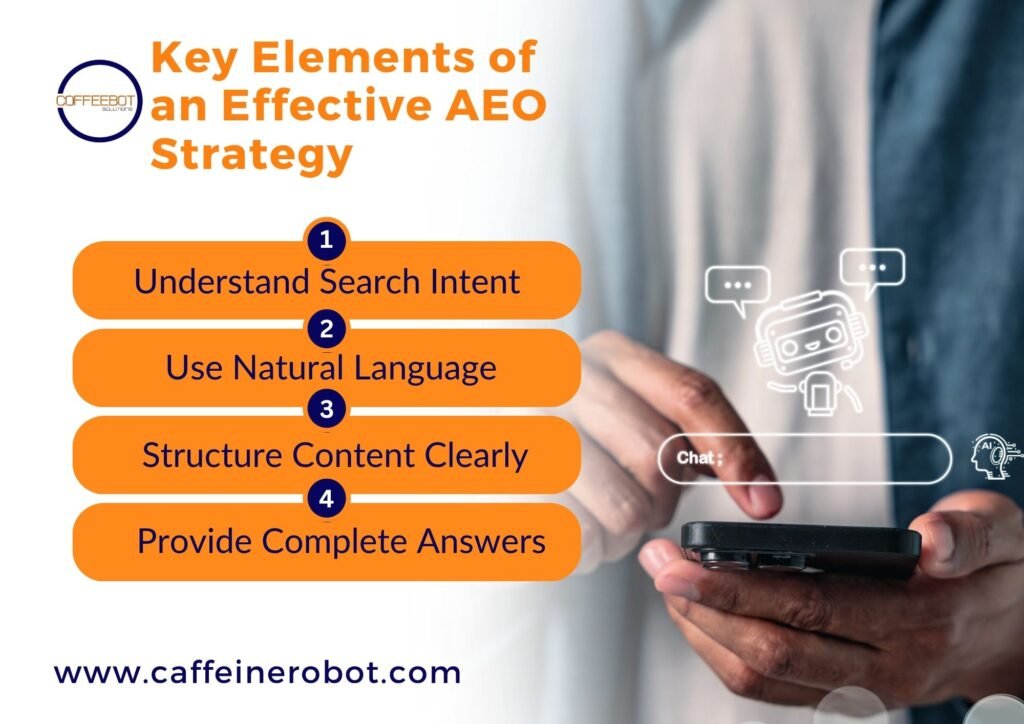
Understand Search Intent
Identify the purpose behind a search. Knowing whether someone wants to learn, compare, or take action helps you create content that fits their needs.
Use Natural Language
Write in a way that reflects how people naturally ask questions and communicate. This keeps your content easy to read and prevents awkward keyword placement.
Structure Content Clearly
Use descriptive headings, short paragraphs, bullet points, and lists to organize your ideas. A clear structure helps readers and answer engines find the main points quickly.
Provide Complete Answers
Address the main question directly, then include the key details needed to explain the topic properly. This gives readers a useful response without making them search elsewhere for basic context.
The goal is simple: create content that is clear, relevant, and easy for your audience to use.
Where Your Answers Can Appear?
Depending on the question and the search platform, your content may appear in several formats:
- Featured snippets: That short, boxed answer at the top of Google.
- People Also Ask: The expanding list of related questions.
- Local panels: Your Google Business Profile’s Q&A, hours, and reviews.
- Voice and AI assistants: The concise responses read or summarized aloud.
This shows that AEO is not limited to one type of search result. Your content can potentially reach people across different search experiences.
AEO vs. SEO: What’s the Difference?
AEO and SEO are closely related, but they focus on different aspects of search visibility. SEO helps your content appear in search results, while AEO focuses on making that content useful and easy for search engines and AI-powered platforms to understand.
| SEO | AEO |
| Focuses on improving a website’s visibility in search results | Focuses on providing direct answers to user questions |
| Targets relevant keywords and search terms | Considers questions, search intent, and conversational queries |
| Helps search engines discover and rank content | Helps answer engines understand and identify useful information |
| Often focuses on rankings and organic traffic | Focuses on visibility in answer-based search experiences |
| Uses keywords, backlinks, technical optimization, and site performance | Uses clear answers, natural language, structured content, and relevant context |
The two approaches are not competing strategies. AEO builds on the foundation of SEO. A page still needs to be discoverable and technically sound. However, it should also provide clear and useful answers to the questions people are asking.
For businesses, the best approach is to combine both. SEO helps people find your content, while AEO helps make that content more relevant and useful once they do.
Need Help With Your Digital Marketing Strategy?
You don’t need to figure out AEO on your own. Our team can help you develop strategies that make your content more useful, accessible, and aligned with how people search for information today.
Reach out to us, and let’s help position your brand as a trusted source of information in your industry.
We redefine digital marketing by delivering customized strategies and innovative campaigns tailored to your business’s unique needs. Our team of skilled digital marketers stays ahead of the curve, utilizing data-driven insights and the latest trends to drive impactful results.